Photo date: January 29, 2016. Photographer: Mark Mahin.
The photo below shows some stores in New York City. We see the light mysteriously rising up in the air. The camera was not moving when the photo was taken, and the exposure time was only 1/30 of a second. Note that all details are sharp except the weirdness with the light.
A closeup shows the strangest part of the photo. We see what looks like a weird "stairway" hanging in the air.
The photo was a flash photos with an exposure time of 1/30 of a second, using normal camera settings (no "Night picture" setting)
Showing posts with label photo uploaded directly from camera. Show all posts
Monday, February 1, 2016
Wednesday, January 27, 2016
Baffling Ascent of the Christmas Tree Light
Photo date: January 22, 2016. Photographer: Mark Mahin.
The photo below shows another example of what I photographed 8 days earlier (as shown here): light from a Christmas tree mysteriously rising way up into the air. The camera was not moving when this photo was taken, as you can tell from the sharp, non-streaked details of the tree on the right, the wire, and even the branches on the left of the tree.
Note that we don't see a streaking of light from the star on the top (as you might have seen if the camera had been moving), but instead a kind of seven-fold cloning of the image of the star, without any streaking between these "clones."
The top photo has been uploaded directly from the camera without any change. The exposure time was only 1/30 of a second.
The photo below shows another example of what I photographed 8 days earlier (as shown here): light from a Christmas tree mysteriously rising way up into the air. The camera was not moving when this photo was taken, as you can tell from the sharp, non-streaked details of the tree on the right, the wire, and even the branches on the left of the tree.
Note that we don't see a streaking of light from the star on the top (as you might have seen if the camera had been moving), but instead a kind of seven-fold cloning of the image of the star, without any streaking between these "clones."
The top photo has been uploaded directly from the camera without any change. The exposure time was only 1/30 of a second.
Saturday, January 23, 2016
"Rising Ghost" of the Squiggly Light Rays
Photo date: January 22, 2016. Photographer: Mark Mahin.
In this series of posts I have shown an incredibly strange photographic anomaly in which light seems to rise up like drifting smoke: the effect I call the light metamorphosis. Below we see another example of this phenomenon. We see light rays that are making two different turns as they rise up. The camera was not moving, as you can tell from the fact that the details of the cars and the windows are completely sharp, and not streaked.
Behold how the light from the sign in the middle seems to rise up like some ascending ghost making a twisty ascent.
Below is another photo taken at the same time. Now the "light ghost" in the middle seems to rise up in a different direction, to the right. Also, half of a white orb can be seen above this "light ghost," one that is not visible in the previous photo.
The photos were flash photos with an exposure time of 1/30 of a second, using normal camera settings (no "Night picture" setting). The photos have been uploaded directly from the camera without any modification.
In this series of posts I have shown an incredibly strange photographic anomaly in which light seems to rise up like drifting smoke: the effect I call the light metamorphosis. Below we see another example of this phenomenon. We see light rays that are making two different turns as they rise up. The camera was not moving, as you can tell from the fact that the details of the cars and the windows are completely sharp, and not streaked.
Behold how the light from the sign in the middle seems to rise up like some ascending ghost making a twisty ascent.
Below is another photo taken at the same time. Now the "light ghost" in the middle seems to rise up in a different direction, to the right. Also, half of a white orb can be seen above this "light ghost," one that is not visible in the previous photo.
The photos were flash photos with an exposure time of 1/30 of a second, using normal camera settings (no "Night picture" setting). The photos have been uploaded directly from the camera without any modification.
Wednesday, January 20, 2016
An Unfathomable Transformation of the Light
Photo date: January 19, 2016. Photographer: Mark Mahin.
In this series of 8 posts I have shown an incredibly strange photographic anomaly in which light seems to rise up like drifting smoke: the effect I call the light metamorphosis. On this day my photos again showed this phenomenon at Grand Central Terminal in New York. The photos below were all taken while the camera was not moving. The first one shows a spectacular curved ascent of light in the station. You can see the photo in higher resolution by opening it in a separate browser tab.
You can tell the camera was not moving from the fact that only the light looks streaked, not the windows, and not the people shown in the photo. The EXIF data on the file shows the exposure time was only 1/30 of a second.
This strange effect did not occur in the first twenty or so photos I took with this camera at this place. Below is one of these photos, which shows Grand Central with its normal appearance.
But then the strange "light metamorphosis" effect kicked in, and I started getting many pictures like the first picture shown above. Below is another of these photos showing an inexplicable transformation of the light. Below we see all of the light in the station seems to move in a curved manner, making two different changes in directions. An orb is visible near the top, underneath one of the strange curved light streams.
The EXIF data on the file shows the exposure time was only 1/30 of a second. On this night I got more than 20 photos like this, all while my camera was held quite stable. I will publish some more of these photos in the near future. These photos were all flash photos, using normal camera settings.
Note the incredible effect above the circular information desk at the center of the station. It looks as if some huge bonfire was lit on top of the desk. But there was no such fire.
The photos shown here were all uploaded directly from the camera without any type of modification. They were taken by an old Olympus point-and-click camera, using normal settings.
In this series of 8 posts I have shown an incredibly strange photographic anomaly in which light seems to rise up like drifting smoke: the effect I call the light metamorphosis. On this day my photos again showed this phenomenon at Grand Central Terminal in New York. The photos below were all taken while the camera was not moving. The first one shows a spectacular curved ascent of light in the station. You can see the photo in higher resolution by opening it in a separate browser tab.
You can tell the camera was not moving from the fact that only the light looks streaked, not the windows, and not the people shown in the photo. The EXIF data on the file shows the exposure time was only 1/30 of a second.
This strange effect did not occur in the first twenty or so photos I took with this camera at this place. Below is one of these photos, which shows Grand Central with its normal appearance.
But then the strange "light metamorphosis" effect kicked in, and I started getting many pictures like the first picture shown above. Below is another of these photos showing an inexplicable transformation of the light. Below we see all of the light in the station seems to move in a curved manner, making two different changes in directions. An orb is visible near the top, underneath one of the strange curved light streams.
The EXIF data on the file shows the exposure time was only 1/30 of a second. On this night I got more than 20 photos like this, all while my camera was held quite stable. I will publish some more of these photos in the near future. These photos were all flash photos, using normal camera settings.
Note the incredible effect above the circular information desk at the center of the station. It looks as if some huge bonfire was lit on top of the desk. But there was no such fire.
The photos shown here were all uploaded directly from the camera without any type of modification. They were taken by an old Olympus point-and-click camera, using normal settings.
Saturday, January 16, 2016
Grand Central Radiantly Transfigured by the Light Metamorphosis
Photo date: January 13, 2016. Photographer: Mark Mahin.
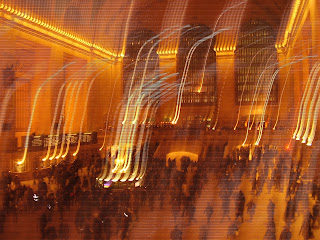
In two previous posts (here and here) I had photos showing a most astonishing effect in which light seems to rise up from a light source like drifting smoke: an inexplicable effect I call the light metamorphosis. Those photos were taken in front of a TV, but I wondered: could the effect appear in a grander setting? Below are some wondrous examples of this effect occurring in Grand Central Terminal in New York.
Open the photo up in a separate tab to see it at higher resolution.
Upon first looking at this photo, you might think that it is rather like some photo you have seen before outside of this blog. But let me explain why such an idea is not correct. There are two types of photos that you might recall when seeing a photo like this. The first type of photo is a photo taken while the camera is moving in a way that causes light to appear as streaks. But when that happens, every element in the photo becomes a blurry streak; and that is not what we see here. Here we see that the architectural elements and the people are not streaks. The only streaks are those coming from light sources in the station. There is no way to get such a photo by merely moving the camera when you take a photo. In fact, my camera was not moving when any of the photos in this post were taken.
Another type of photo that you might recall when seeing this photo is one of those long-exposure photos that shows little streaks of light at the bottom (caused by people moving about), while the area above the bottom does not look streaked. But this is not such a photo. The streaks do not come from any moving objects, but only from stationary objects: the lights of the station. The photo above had an exposure time of less than a second (.68 second), so it was not a long exposure photo.
Notice the squiggly motion of the light in the photo above. You could never get that from moving the camera within a single second, because you couldn't make so many changes of direction so quickly.
Below is another photo from the same day.
Now the direction of the wondrous "light drift" has changed. The light now seems to rise up like smoke, but it drifts toward the left. The centrally located circular information desk looks almost as if it is on fire, but it is not. The EXIF data on this photo shows the exposure time was only 1/30 of a second.
Below is another photo from the same day. The exposure time was less than a second.
Now the preternatural "light drift" has changed direction again -- the light drifts to the right. Notice the very strange part at the end of these light streaks, where the streak does a little "U-turn" thing, changing direction back to the left.
Below is another photo from the same day. The exposure time was less than a second.
Below is another photo from the same day. The exposure time was 1/30 of a second. Notice how in this photo the light seems to fall down, like water dripping down from a fountain.
Below is another photo from the same day. The exposure time was only 1/30 of a second.
These photos are all entirely authentic unaltered photos that have been uploaded directly from the camera without any modification at all. You can be sure they are authentic, because there is simply no way to fake a photo series like this, and end up with photos like those I have provided here. You cannot create an effect like this by moving your camera, because if you do that everything in the photo will appear streaky and blurry -- but in these photos nothing appears streaky except streaks coming from the existing lights. You cannot create photos like this by using a long exposure, because a long exposure will show lights like those we see here completely normal (since lights here don't move), and will show the crowd looking all streaky. But that's the opposite of what we see here. You also could not fake photos like this using software, because no software has a function or feature that produces this effect.
What we see here is the same paranormal effect involved in the photo below I published earlier. If you zoom in to the photo, you will see that every letter in the phrase "Music Choice" has its own little streak of light rising up from it.
I may note that the camera producing these photos is an old point-and-click Olympus camera. It only produces this strange effect occasionally, taking normal photos most of the time. The effect only can be seen in photos, and I do not see it with my eyes.
Encountering this manifestation, I can only feel the same type of awe shown in that lunar monolith excavation scene in 2001: A Space Odyssey, the scene where an awe-filled Dr. Heywood Floyd touches the monolith, encountering a manifestation of a power utterly beyond his understanding.
The photos in this post were are all flash photos taken with normal camera settings (no "Night photo" settings).
In two previous posts (here and here) I had photos showing a most astonishing effect in which light seems to rise up from a light source like drifting smoke: an inexplicable effect I call the light metamorphosis. Those photos were taken in front of a TV, but I wondered: could the effect appear in a grander setting? Below are some wondrous examples of this effect occurring in Grand Central Terminal in New York.
Open the photo up in a separate tab to see it at higher resolution.
Upon first looking at this photo, you might think that it is rather like some photo you have seen before outside of this blog. But let me explain why such an idea is not correct. There are two types of photos that you might recall when seeing a photo like this. The first type of photo is a photo taken while the camera is moving in a way that causes light to appear as streaks. But when that happens, every element in the photo becomes a blurry streak; and that is not what we see here. Here we see that the architectural elements and the people are not streaks. The only streaks are those coming from light sources in the station. There is no way to get such a photo by merely moving the camera when you take a photo. In fact, my camera was not moving when any of the photos in this post were taken.
Another type of photo that you might recall when seeing this photo is one of those long-exposure photos that shows little streaks of light at the bottom (caused by people moving about), while the area above the bottom does not look streaked. But this is not such a photo. The streaks do not come from any moving objects, but only from stationary objects: the lights of the station. The photo above had an exposure time of less than a second (.68 second), so it was not a long exposure photo.
Notice the squiggly motion of the light in the photo above. You could never get that from moving the camera within a single second, because you couldn't make so many changes of direction so quickly.
Below is another photo from the same day.
Now the direction of the wondrous "light drift" has changed. The light now seems to rise up like smoke, but it drifts toward the left. The centrally located circular information desk looks almost as if it is on fire, but it is not. The EXIF data on this photo shows the exposure time was only 1/30 of a second.
Below is another photo from the same day. The exposure time was less than a second.
Now the preternatural "light drift" has changed direction again -- the light drifts to the right. Notice the very strange part at the end of these light streaks, where the streak does a little "U-turn" thing, changing direction back to the left.
Below is another photo from the same day. The exposure time was less than a second.
Below is another photo from the same day. The exposure time was 1/30 of a second. Notice how in this photo the light seems to fall down, like water dripping down from a fountain.
Below is another photo from the same day. The exposure time was only 1/30 of a second.
These photos are all entirely authentic unaltered photos that have been uploaded directly from the camera without any modification at all. You can be sure they are authentic, because there is simply no way to fake a photo series like this, and end up with photos like those I have provided here. You cannot create an effect like this by moving your camera, because if you do that everything in the photo will appear streaky and blurry -- but in these photos nothing appears streaky except streaks coming from the existing lights. You cannot create photos like this by using a long exposure, because a long exposure will show lights like those we see here completely normal (since lights here don't move), and will show the crowd looking all streaky. But that's the opposite of what we see here. You also could not fake photos like this using software, because no software has a function or feature that produces this effect.
What we see here is the same paranormal effect involved in the photo below I published earlier. If you zoom in to the photo, you will see that every letter in the phrase "Music Choice" has its own little streak of light rising up from it.
I may note that the camera producing these photos is an old point-and-click Olympus camera. It only produces this strange effect occasionally, taking normal photos most of the time. The effect only can be seen in photos, and I do not see it with my eyes.
Encountering this manifestation, I can only feel the same type of awe shown in that lunar monolith excavation scene in 2001: A Space Odyssey, the scene where an awe-filled Dr. Heywood Floyd touches the monolith, encountering a manifestation of a power utterly beyond his understanding.
The photos in this post were are all flash photos taken with normal camera settings (no "Night photo" settings).
Saturday, September 19, 2015
Cluster of the Sky Mysteries
Photo date: September 8, 2015. Photographer: Mark Mahin.
The photo below was taken at 9:00 PM in front of the Schwarzman branch of the New York Public Library. We see a rich swarm of mysterious orbs. Right click to see the photo (which was uploaded directly from the camera) at its full resolution.
The previous photo I took (also at 9:00 PM) was of a photo of a piece of cardboard at arm's length. This showed no orbs in front of the camera, indicating that what I was photographing was not any particles in front of the camera such as dust.
Notice the presence of only one small orb in the bottom right part of the photo. I have seen this "orb vertical bias" in many photos that I have labeled with that tag -- the orbs appearing in great numbers above some foreground building, but almost none in front of that building (which we would not at all expect from natural particles near the camera, which would be randomly scattered across the photo area).
The photo below was taken at 9:00 PM in front of the Schwarzman branch of the New York Public Library. We see a rich swarm of mysterious orbs. Right click to see the photo (which was uploaded directly from the camera) at its full resolution.
The previous photo I took (also at 9:00 PM) was of a photo of a piece of cardboard at arm's length. This showed no orbs in front of the camera, indicating that what I was photographing was not any particles in front of the camera such as dust.
Notice the presence of only one small orb in the bottom right part of the photo. I have seen this "orb vertical bias" in many photos that I have labeled with that tag -- the orbs appearing in great numbers above some foreground building, but almost none in front of that building (which we would not at all expect from natural particles near the camera, which would be randomly scattered across the photo area).
Friday, September 18, 2015
100+ Orb "Comet Tails" All Pointing in the Same Direction
Photo date: September 16, 2015. Photographer: Mark Mahin.
The photo below was taken in front of a building in New York City. We see a dense swarm of orbs. Right click to see the photo at its full resolution.
If you right click on this photo and open it in a separate tab or window, and then load the photo in a photo viewer allowing you to zoom in, you will discover something very unusual. The photo shows more than 100 objects that have "comet tails." You can see this very clearly if you use your photo editor to make a negative version of this image.
What is remarkable is that all of these many "orb comet tails" are all pointing in the same direction. It is as if the photo has captured a great body of objects all moving in a south-westerly direction.
Below is a closeup of part of the photo (I used the IrfanView "Auto-adjust colors" menu option on the closeup). You can see here two larger orbs with "comet tails." But if you look closely you can also see many other much smaller objects (or more distant objects?) that also seem to have "comet tails." They all seem to be moving in the same south-westerly direction.
The top photo was taken at 10:44 PM. The next photo was the photo below, also taken at 10:44 PM. I photographed a piece of cardboard at arm's length to see whether my previous photo might have been showing particles near the camera. As always, this "cardboard test" was negative, showing no orbs in front of the cardboard -- thereby indicating that the previous photo does not show particles such as dust near the camera.
There was no fog, mist, rain, or precipitation on this night. The air quality listed on airnow.gov was "moderate," with a rating of 52 that was almost good enough to qualify as "good." I noticed nothing unusual nearby, and did not see a single insect on this night.
A photo similar to the top photo (and one that is even more dramatic) can be seen here on Yvonne Scouller's site. That photo also shows a dense swarm of moving orbs, with larger moving orbs outnumbered by smaller moving orbs.
The photo below was taken in front of a building in New York City. We see a dense swarm of orbs. Right click to see the photo at its full resolution.
If you right click on this photo and open it in a separate tab or window, and then load the photo in a photo viewer allowing you to zoom in, you will discover something very unusual. The photo shows more than 100 objects that have "comet tails." You can see this very clearly if you use your photo editor to make a negative version of this image.
What is remarkable is that all of these many "orb comet tails" are all pointing in the same direction. It is as if the photo has captured a great body of objects all moving in a south-westerly direction.
Below is a closeup of part of the photo (I used the IrfanView "Auto-adjust colors" menu option on the closeup). You can see here two larger orbs with "comet tails." But if you look closely you can also see many other much smaller objects (or more distant objects?) that also seem to have "comet tails." They all seem to be moving in the same south-westerly direction.
The top photo was taken at 10:44 PM. The next photo was the photo below, also taken at 10:44 PM. I photographed a piece of cardboard at arm's length to see whether my previous photo might have been showing particles near the camera. As always, this "cardboard test" was negative, showing no orbs in front of the cardboard -- thereby indicating that the previous photo does not show particles such as dust near the camera.
There was no fog, mist, rain, or precipitation on this night. The air quality listed on airnow.gov was "moderate," with a rating of 52 that was almost good enough to qualify as "good." I noticed nothing unusual nearby, and did not see a single insect on this night.
A photo similar to the top photo (and one that is even more dramatic) can be seen here on Yvonne Scouller's site. That photo also shows a dense swarm of moving orbs, with larger moving orbs outnumbered by smaller moving orbs.
Wednesday, September 9, 2015
Glimpse of an Unfathomable Reality
Photo date: September 8, 2015. Photographer: Mark Mahin.
The photo below was taken at 8:59 PM in front of the Schwarzman branch of the New York Public Library. We see an astonishing swarm of orbs. Right click to see the photo (which was uploaded directly from the camera) at its full resolution.
A photo of a piece of cardboard at arm's length taken a few photos earlier (also at 8:59 PM) had showed no orbs.
A photo of a piece of cardboard at arm's length taken a few photos later (at 9:00 PM) showed no orbs
These tests clearly indicate the first photo was not showing any particles (such as dust) very near the camera. The same thing is indicated by the fact that we see a dense swarm of orbs above the building in the top right corner, but almost no orbs in front of that building. If I had been photographing particles very near the camera, they would have been distributed evenly across the photo area.
There was no fog, mist, rain, or precipitation on this night. The air quality listed on airnow.gov was "good," with a rating of 50. There was nothing unusual nearby that I could see with my eyes or smell.
The photo below was taken at 8:59 PM in front of the Schwarzman branch of the New York Public Library. We see an astonishing swarm of orbs. Right click to see the photo (which was uploaded directly from the camera) at its full resolution.
A photo of a piece of cardboard at arm's length taken a few photos earlier (also at 8:59 PM) had showed no orbs.
A photo of a piece of cardboard at arm's length taken a few photos later (at 9:00 PM) showed no orbs
These tests clearly indicate the first photo was not showing any particles (such as dust) very near the camera. The same thing is indicated by the fact that we see a dense swarm of orbs above the building in the top right corner, but almost no orbs in front of that building. If I had been photographing particles very near the camera, they would have been distributed evenly across the photo area.
There was no fog, mist, rain, or precipitation on this night. The air quality listed on airnow.gov was "good," with a rating of 50. There was nothing unusual nearby that I could see with my eyes or smell.
Wednesday, August 26, 2015
Spooky Swarm: 7 Photos of an Orb Storm
Photo date: August 24, 2015. Photographer: Mark Mahin.
The photos below were all taken at 10:00 PM on August 24, 2015. Although the results will look quite similar to what was shown in this previous post, these photos are from one week later.
Below is the first photo in the series, which shows not very much going on. We see the Chrysler Building, the Met Life Building, and Grand Central Station.
The next photo in the series shows a huge swarm of orbs.
The next photo in the series also shows a huge swarm of orbs.
The next photo in the series shows a piece of cardboard I photographed at arm's length, to verify that the orbs I was seeing were not natural particles near the camera. As always, this test showed no orbs in front of the cardboard, indicating I was not photographing natural particles (such as dust) near the camera. (See my 23 posts labeled "cardboard test" for other similar tests in the middle of photographing many orbs, none showing any orbs in front of the cardboard.)
The next photo in the series shows a huge swarm of orbs.
The next photo in the series shows a huge swarm of orbs. Notice how some of the orbs seem to form a kind of angle shape that is rather similar to the triangular top of the Chrysler Building.
The next photo in the series shows a much smaller number of orbs.
The last photo in the series shows quite a few orbs.
Notice how this series of photos shows more than 500 orbs above the building at bottom (Grand Central Station), but we see a total of only about 7 orbs in front of that building (all of which are very small). This overwhelming "orb vertical bias" is very strong evidence that we are not seeing any type of natural particles (such as dust) floating near the camera. If these photos showed natural particles near the camera, such particles would be randomly distributed around the photo area.
In the posts here, here, and here we also see equally strong evidence of this "orb vertical bias." In all of those posts, we see a series of photos in which there are hundreds of orbs floating above a building at the bottom of the photo, with almost no orbs in front of that building. Such observations very strongly discredit any theory that natural particles near the camera are the source of the orbs in these photos.
There was no fog, mist, rain, or precipitation on this night. The air quality listed on airnow.gov was "good," with a rating of 39. The photos showing orbs in this post were all uploaded directly from the camera, without any cropping or changes of any type. You can right-click on these high resolution photos to see them at their full resolution.
The photos below were all taken at 10:00 PM on August 24, 2015. Although the results will look quite similar to what was shown in this previous post, these photos are from one week later.
Below is the first photo in the series, which shows not very much going on. We see the Chrysler Building, the Met Life Building, and Grand Central Station.
The next photo in the series shows a huge swarm of orbs.
The next photo in the series also shows a huge swarm of orbs.
The next photo in the series shows a piece of cardboard I photographed at arm's length, to verify that the orbs I was seeing were not natural particles near the camera. As always, this test showed no orbs in front of the cardboard, indicating I was not photographing natural particles (such as dust) near the camera. (See my 23 posts labeled "cardboard test" for other similar tests in the middle of photographing many orbs, none showing any orbs in front of the cardboard.)
The next photo in the series shows a huge swarm of orbs.
The next photo in the series shows a huge swarm of orbs. Notice how some of the orbs seem to form a kind of angle shape that is rather similar to the triangular top of the Chrysler Building.
The next photo in the series shows a much smaller number of orbs.
The last photo in the series shows quite a few orbs.
Notice how this series of photos shows more than 500 orbs above the building at bottom (Grand Central Station), but we see a total of only about 7 orbs in front of that building (all of which are very small). This overwhelming "orb vertical bias" is very strong evidence that we are not seeing any type of natural particles (such as dust) floating near the camera. If these photos showed natural particles near the camera, such particles would be randomly distributed around the photo area.
In the posts here, here, and here we also see equally strong evidence of this "orb vertical bias." In all of those posts, we see a series of photos in which there are hundreds of orbs floating above a building at the bottom of the photo, with almost no orbs in front of that building. Such observations very strongly discredit any theory that natural particles near the camera are the source of the orbs in these photos.
There was no fog, mist, rain, or precipitation on this night. The air quality listed on airnow.gov was "good," with a rating of 39. The photos showing orbs in this post were all uploaded directly from the camera, without any cropping or changes of any type. You can right-click on these high resolution photos to see them at their full resolution.
Friday, August 7, 2015
P.S. Paranormal
Photo date: July 15, 2015. Photographer: Mark Mahin.
The photo below was uploaded directly from the camera, and has not been cropped. We see a New York City public school. On the left is an orb that is 10 percent of the original photo height (rounding up). It is certainly not the moon, which wasn't even visible as a thin crescent on this day.
It is interesting to do a blockage fraction calculation to calculate the maximum size in a photo that a suspended dust particle could have. Dust particles suspended in the air are never larger than 1000 microns (a millimeter), and the area right in front of a camera lens is about 15,000 microns (15 millimeters). This means even if you had the largest suspended dust particle possible floating in front of a camera (which would only appear in a choking dust storm), you still could not get a dust orb in a photo larger than 7% of the photo height. But this orb is 10 percent of the photo height.
The air quality on this day was listed as "good" on airnow.gov, and in regular air like that the actual dust particles in the air are only about 1 micron, more than 1000 times too small to produce an orb like this. There was no fog, mist, rain, or precipitation on this night. The pollen count was low to medium, with a level of 4.4.
For similar photos showing orbs as large (or even much larger), see my posts labeled "air orb too large to be dust" and "giant purple air orb."
The photo below was uploaded directly from the camera, and has not been cropped. We see a New York City public school. On the left is an orb that is 10 percent of the original photo height (rounding up). It is certainly not the moon, which wasn't even visible as a thin crescent on this day.
It is interesting to do a blockage fraction calculation to calculate the maximum size in a photo that a suspended dust particle could have. Dust particles suspended in the air are never larger than 1000 microns (a millimeter), and the area right in front of a camera lens is about 15,000 microns (15 millimeters). This means even if you had the largest suspended dust particle possible floating in front of a camera (which would only appear in a choking dust storm), you still could not get a dust orb in a photo larger than 7% of the photo height. But this orb is 10 percent of the photo height.
The air quality on this day was listed as "good" on airnow.gov, and in regular air like that the actual dust particles in the air are only about 1 micron, more than 1000 times too small to produce an orb like this. There was no fog, mist, rain, or precipitation on this night. The pollen count was low to medium, with a level of 4.4.
For similar photos showing orbs as large (or even much larger), see my posts labeled "air orb too large to be dust" and "giant purple air orb."
Sunday, August 2, 2015
Puzzling Purple Plethora
Photo date: July 29, 2015. Photographer: Mark Mahin.
The photo below (taken at 9:02 PM) shows a surge of purple orbs on Fifth Avenue in New York City. This is the full original photo, without any cropping.
How can we tell that these orbs are not dust near the camera? For one thing, the largest orb is way too big to be a dust particle (as discussed here, outdoor dust particles are only about 1 micron in size, only about 1/15000 of the width just in front of a camera lens). For another thing, we see almost no orbs in the bottom third of the photo. If we were seeing particles in front of the camera, they would be randomly distributed around the photo area; but they are not.
A photo of a piece of cardboard at arm's length taken during the same minute (9:02 PM) showed no orbs (indicating that the previous photo was not showing particles near the camera).
There was no fog, mist, rain, or precipitation on this night. The air quality as listed on airnow.gov was "moderate." When I took these photos, there was nothing unusual I could see with my eyes, and I could not smell anything unusual.
The photo below (taken at 9:02 PM) shows a surge of purple orbs on Fifth Avenue in New York City. This is the full original photo, without any cropping.
How can we tell that these orbs are not dust near the camera? For one thing, the largest orb is way too big to be a dust particle (as discussed here, outdoor dust particles are only about 1 micron in size, only about 1/15000 of the width just in front of a camera lens). For another thing, we see almost no orbs in the bottom third of the photo. If we were seeing particles in front of the camera, they would be randomly distributed around the photo area; but they are not.
A photo of a piece of cardboard at arm's length taken during the same minute (9:02 PM) showed no orbs (indicating that the previous photo was not showing particles near the camera).
There was no fog, mist, rain, or precipitation on this night. The air quality as listed on airnow.gov was "moderate." When I took these photos, there was nothing unusual I could see with my eyes, and I could not smell anything unusual.
Saturday, August 1, 2015
Mysterious Orbs Swarm Behind a Famous Building
Photo date: July 29, 2015. Photographer: Mark Mahin.
The photo below was taken at 9:32 PM on a dry night in New York City. We see in the front the Schwartzman branch of the New York Public Library, commonly known as "the main branch." Behind the building we see a mysterious swarm of orbs.
This photo offers unmistakable visual evidence that we are seeing something mysterious that is not at all some particles (such as dust or mist) right near the camera. If this dense swarm of orbs was near the camera, we would see the orbs scattered randomly throughout the photo area. But we see no (or virtually no) orbs in the lower right quarter of the photo.
There was no fog, mist, rain, or precipitation on this night. The air quality as listed on airnow.gov was "moderate." When I took these photos, there was nothing unusual I could see with my eyes, and I could not smell anything unusual.
The photo below was taken at 9:32 PM on a dry night in New York City. We see in the front the Schwartzman branch of the New York Public Library, commonly known as "the main branch." Behind the building we see a mysterious swarm of orbs.
This photo offers unmistakable visual evidence that we are seeing something mysterious that is not at all some particles (such as dust or mist) right near the camera. If this dense swarm of orbs was near the camera, we would see the orbs scattered randomly throughout the photo area. But we see no (or virtually no) orbs in the lower right quarter of the photo.
There was no fog, mist, rain, or precipitation on this night. The air quality as listed on airnow.gov was "moderate." When I took these photos, there was nothing unusual I could see with my eyes, and I could not smell anything unusual.
Thursday, July 30, 2015
A Mystifying Horde of Orbs
Photo date: July 29, 2015. Photographer: Mark Mahin.
The photo below was taken at 9:30 PM in front of the main branch of the New York Public Library. We see an astonishing swarm of orbs. The photo has been uploaded directly from the camera, without any cropping.
The photo I took a few seconds earlier (also at 9:30), shown below, was of a piece of cardboard at arm's length. This showed no orbs, indicating that what is shown in the photo above is not at all dust.
The next photo (also at 9:30) also showed a huge swarm of orbs.
But the next photo, also taken at 9:30 (of a piece of cardboard at arm's length), also showed no orbs.
As in all of the many times I have tried it (while in the middle of photographing many orbs), this cardboard test showed no orbs, strongly indicating that what I was photographing was definitely not particles (such as dust) near the camera lens. Another thing indicating that we are not seeing dust is the fact that in the first photo we see none of the orbs in front of the building at the bottom right. If I had been photographing particles near the camera, we would have seen the particles scattered evenly across the picture area.
The next photo (taken at 9:31 PM) again showed a big swarm of orbs.
There was no fog, mist, rain, or precipitation on this night. The air quality as listed on airnow.gov was "moderate." When I took these photos, there was nothing unusual I could see with my eyes, and I could not smell anything unusual.
The photo below was taken at 9:30 PM in front of the main branch of the New York Public Library. We see an astonishing swarm of orbs. The photo has been uploaded directly from the camera, without any cropping.
The photo I took a few seconds earlier (also at 9:30), shown below, was of a piece of cardboard at arm's length. This showed no orbs, indicating that what is shown in the photo above is not at all dust.
The next photo (also at 9:30) also showed a huge swarm of orbs.
But the next photo, also taken at 9:30 (of a piece of cardboard at arm's length), also showed no orbs.
As in all of the many times I have tried it (while in the middle of photographing many orbs), this cardboard test showed no orbs, strongly indicating that what I was photographing was definitely not particles (such as dust) near the camera lens. Another thing indicating that we are not seeing dust is the fact that in the first photo we see none of the orbs in front of the building at the bottom right. If I had been photographing particles near the camera, we would have seen the particles scattered evenly across the picture area.
The next photo (taken at 9:31 PM) again showed a big swarm of orbs.
There was no fog, mist, rain, or precipitation on this night. The air quality as listed on airnow.gov was "moderate." When I took these photos, there was nothing unusual I could see with my eyes, and I could not smell anything unusual.
Sunday, July 26, 2015
Cathedral Conundrum
Photo date: July 24, 2015. Photographer: Mark Mahin.
A conundrum is defined as a "confusing or difficult problem or question." That is an apt description of what this large orb is doing floating over St. Patrick's Cathedral in New York.
This orb sure wasn't the moon, as the next photograph showed no such orb (although it did show a smaller orb).
Both of these photos were uploaded directly from the camera, without any cropping. The orb in the top photo is 9.4% of the original photo height. Even if you deliberately raise lots of dust and take photos, you will not see dust orbs this large (as a fraction of the original photo height).
There was no fog, mist, rain, or precipitation on this night. The local air quality listed on airnow.gov was "good.".
A conundrum is defined as a "confusing or difficult problem or question." That is an apt description of what this large orb is doing floating over St. Patrick's Cathedral in New York.
This orb sure wasn't the moon, as the next photograph showed no such orb (although it did show a smaller orb).
Both of these photos were uploaded directly from the camera, without any cropping. The orb in the top photo is 9.4% of the original photo height. Even if you deliberately raise lots of dust and take photos, you will not see dust orbs this large (as a fraction of the original photo height).
There was no fog, mist, rain, or precipitation on this night. The local air quality listed on airnow.gov was "good.".
Friday, July 24, 2015
Giant Purple Orb "Follows the Script"
Photo date: July 23, 2015. Photographer: Mark Mahin.
Periodically when I go out to photograph at night, I will get a giant purple orb in my photos, as you can see in my posts labeled "giant purple air orb." On pretty much any night I get a series of photos showing such a thing, it is as if some giant purple orb was "following a script," in the sense that the same distinctive things are seen. The "script" goes like this:
(1) I will notice a giant purple orb on the left edge of my photo (never the right edge), with the photo showing only the left half of the orb.
(2) The orb seems to appear in about 8 to 20 of the next photos I take.
(3) As I am taking these photos, whenever I point my camera downward and photograph the ground, the orb will no longer be seen. But it will be then seen again as soon as I point my camera up at the sky.
(4) After about 8 to 12 photos, the orb will start to fade away, until it no longer is seen. No further photos that night will show the giant purple orb.
Yesterday I again saw exactly this pattern being "acted out." The photos below are all uploaded directly from the camera, without any cropping or color adjustment.
After appearing less brightly in a few photos, the orb showed up brightly in the photo below taken at 9:32 PM.
The next photo (taken also at 9:32 PM) showed the giant purple orb behind a fence. A closeup inspection of the top fence will show that the area in front of the orb looks no different from the area to the right of the orb, clearly indicating the orb was behind the fence that was more than a meter from my camera.
The next photo (taken at 9:33 PM) shows the giant purple orb halfway blocked by a concrete barrier, further showing that it was not within arm's length of my camera. Note also the two other orbs in the top of the photo, one of which is a rare orange orb.
Then I took a photo of the ground (also at 9:33), which showed no sign of the orb.
But the next photo (also at 9:33) showed the orb appearing again, clearly behind the barrier more than a meter from my camera.
Then after turning 180 degrees I took a photo at 9:34, in which the orb was again clearly visible, along with another orb floating in the middle of the photo.
The next few photos also showed the orb, but it seemed to fade away, seeming to get a little dimmer in each photo. After about 10 more photos, there was no sign of the orb.
The fact that these photos were taken in very dark locations (with no bright light nearby) rules out the possibility that lens flare was causing this. The appearance of the orb behind the distant obstruction rules out dust as an explanation, as does the huge size of the orb (no one ever photographs dust orbs looking even half as big as this object).
So far (in my posts labeled "giant purple air orb") I have about 35 photographs of such an orb, with it always appearing on the left side of the photo. A rough calculation of the probability of this occurring by chance would be 1 in X, where X is 2 raised to the 35th power, which is a probability of about 1 in 34 billion.
There was no fog,mist, rain, or precipitation on this night. I forgot to check the air quality at airnow.gov, but I can see from this link that the local air quality in New York City was good.
Periodically when I go out to photograph at night, I will get a giant purple orb in my photos, as you can see in my posts labeled "giant purple air orb." On pretty much any night I get a series of photos showing such a thing, it is as if some giant purple orb was "following a script," in the sense that the same distinctive things are seen. The "script" goes like this:
(1) I will notice a giant purple orb on the left edge of my photo (never the right edge), with the photo showing only the left half of the orb.
(2) The orb seems to appear in about 8 to 20 of the next photos I take.
(3) As I am taking these photos, whenever I point my camera downward and photograph the ground, the orb will no longer be seen. But it will be then seen again as soon as I point my camera up at the sky.
(4) After about 8 to 12 photos, the orb will start to fade away, until it no longer is seen. No further photos that night will show the giant purple orb.
Yesterday I again saw exactly this pattern being "acted out." The photos below are all uploaded directly from the camera, without any cropping or color adjustment.
After appearing less brightly in a few photos, the orb showed up brightly in the photo below taken at 9:32 PM.
The next photo (taken also at 9:32 PM) showed the giant purple orb behind a fence. A closeup inspection of the top fence will show that the area in front of the orb looks no different from the area to the right of the orb, clearly indicating the orb was behind the fence that was more than a meter from my camera.
The next photo (taken at 9:33 PM) shows the giant purple orb halfway blocked by a concrete barrier, further showing that it was not within arm's length of my camera. Note also the two other orbs in the top of the photo, one of which is a rare orange orb.
Then I took a photo of the ground (also at 9:33), which showed no sign of the orb.
But the next photo (also at 9:33) showed the orb appearing again, clearly behind the barrier more than a meter from my camera.
Then after turning 180 degrees I took a photo at 9:34, in which the orb was again clearly visible, along with another orb floating in the middle of the photo.
The next few photos also showed the orb, but it seemed to fade away, seeming to get a little dimmer in each photo. After about 10 more photos, there was no sign of the orb.
The fact that these photos were taken in very dark locations (with no bright light nearby) rules out the possibility that lens flare was causing this. The appearance of the orb behind the distant obstruction rules out dust as an explanation, as does the huge size of the orb (no one ever photographs dust orbs looking even half as big as this object).
So far (in my posts labeled "giant purple air orb") I have about 35 photographs of such an orb, with it always appearing on the left side of the photo. A rough calculation of the probability of this occurring by chance would be 1 in X, where X is 2 raised to the 35th power, which is a probability of about 1 in 34 billion.
There was no fog,mist, rain, or precipitation on this night. I forgot to check the air quality at airnow.gov, but I can see from this link that the local air quality in New York City was good.
Subscribe to:
Posts (Atom)


