The graph below shows how often different orb colors have appeared in my photos. I made the graph below by using the numbers in the Labels section of this blog. For example, for the number of blue orbs, I used the number of 672, because I have 672 posts which have the "blue air orb" label.
I have published over 1000 photos showing orbs with colors other than white. Such colors are inexplicable under assumptions that orbs are caused by natural factors, for the reasons discussed here.
The photo below shows how colorless are dust orbs, which never appear under common natural conditions because natural suspended dust particles are too small. In this case I created the dust orbs through the utterly unnatural technique of squeezing a dust-filled cloth in front of the camera. As we can see, the resulting dust orbs are colorless, featureless, dim, and with blurry edges. Contrast these with the orbs shown on this site, which are so often colorful, bright, and with sharp edges and face-like details or stripes or outer rings.
Showing posts with label dust orbs. Show all posts
Sunday, September 25, 2016
Tuesday, July 28, 2015
The Math Showing That Orbs Are Not Dust, Pollen, or Water Vapor
Orbs are strange-looking circular objects that show up in photos, without any obvious explanation. There
are skeptics out there who claim that most of the orbs in photos are
just dust. These skeptics all have one thing in common: they forgot
to do their math before making such a claim. Let's do the math, which
will show that the “orbs are dust” claim is nonsense. Similar math will debunk the idea that pollen or water vapor can explain orbs.
The
Math Relating to Dust and Orbs
To
do this math, we must consider a simple ratio that I will call the
blockage fraction. The blockage fraction is the ratio between
the width of a natural particle floating in the air, and the width of
the area right in front of a camera lens. Computing such a ratio will
tell us whether it is reasonable to think that suspended dust
particles in normal air might be big enough to appear as visible orbs
in photographs.
For
a point-and-click camera, a simple measurement is enough to show the
width of the area right in front of the camera lens. This width is
roughly 15 millimeters.
But
what about the width of natural particles suspended in the air?
Although a skeptic may try to “cloud the waters” here by
suggesting this is a matter of great uncertainty, it is no such
thing. The size of particles floating in the air is settled science
widely used by air quality experts, pollution experts, and
meteorologists. Scientists have electronic instruments that allow
them to measure such particle widths very exactly. Do a Google search for
“particle size chart” and you will get quite a few charts that
all give pretty much the same numbers (such as those shown in this
wikipedia.org article on particulates).
There
is general agreement about the following particle size estimates,
although estimates may vary by as much as 50%. A micron is a
thousandth of a millimeter, or a millionth of a meter. You can find many charts like the one below by doing a Google image search for "particle size chart."
| Condition of air | Particle size |
| Outdoor air, dry | 1 micron |
| Indoors, normal | 10 microns |
| Indoor dust spikes (vacuuming, etc.) | 50 microns |
| Outdoor heavy smog | 30 microns |
| Heavy fog, mist | 500 microns |
| Heavy visible dust in air, reducing visibility | 500 microns |
| Rain | 1000 microns or more |
Now
let's plug these numbers into a spreadsheet that computes the
blockage fractions. The spreadsheet is
below. The numbers in the fourth column are simply the numbers in
the second column divided by the numbers in the third column.
Air Condition |
Particle size (microns) | Length of area right in
front of lens (microns) |
Blockage fraction (maximum size of natural orb as fraction of original photo width) | Would you notice a photo orb caused by a natural particle suspended in air? |
| Outdoor air, dry | 1 | 15000 | 0.00007 or 1/15000 |
No |
| Indoors, normal | 10 | 15000 | 0.00067 or 1/1500 |
No |
| Indoor, dust spikes (vacuuming, etc.) | 50 | 15000 | 0.0033 or 1/300 |
No |
| Outdoor heavy smog | 30 | 15000 | 0.002 or 1/500 |
No |
| Thick fog or mist | 500 | 15000 | 0.03 or 1/30 | Maybe |
| Heavy visible dust in air, reducing visibility | 500 | 15000 | 0.03 or 1/30 | Maybe |
| Rain | 1000 or more | 15000 | 0.07 or more | Maybe |
This
table tells us how absurd is the notion that dust particles in
ordinary outdoor air are sufficient to produce orbs in photographs.
Since such particles cannot block more than about 1/15000 (one
fifteen thousandth) of the original photo width, they are many times
too small to produce noticeable orbs in photos. This table also tells
us that dust particles in ordinary indoor air are way too small to
produce orbs in photos. Such particles cannot block more than about
1/1500 (one fifteen hundredth) of the original photo width.
You
also need not suspect that some orb in an indoor photo was caused by
some dust spike causing the average particle size to rise as high as
500 microns – not unless the visibility was sharply reduced, and
the air was visibly thick with dust. Whenever the air becomes filled
with particle sizes larger than 100 microns, they decrease visibility
quite noticeably, because the human eye can detect particles as large
as 50 microns. So unless you were blasting out a wall during
construction or toppling a large book case or making a big mess in
the kitchen with lots of baking powder flying around – or doing
something else that caused a noticeable decrease in visibility –
there is no chance that the natural particles in the air were
sufficient to produce noticeable orbs in a photo. Particles as large
as 100 microns or larger always settle to the ground fairly quickly,
at a rate of about a meter per six minutes. So indoor dust spikes
quickly die out.
Could
it be that we might get a different “blockage fraction” when we
consider not a point-and-shoot camera but an expensive DSLR camera
with a much wider lens? Yes, but in this case the “blockage
fraction” would not be larger, but 50% smaller. So things aren't
helped if a skeptic assumes a big camera lens was used – in fact,
it then becomes twice as hard to believe that natural particles may
have caused an orb.
In
this discussion I have been extremely generous to the skeptic, by
assuming pretty much the smallest possible “length of area right in
front of lens” (the second column in the spreadsheet above). In
fact, any particle photographed right next to the camera lens will
appear as very blurred. When considering an orb that appears with a
sharp, non-blurred edge, you must consider a “length of area right
in front of lens” to be 2 or 3 times larger than 15 millimeters.
That results in a “blockage fraction” that is even smaller (by a
factor of two or three times) than the fractions shown above, which
just makes it two or three times more unlikely than orbs in ordinary
air could be produced by natural particles.
These
considerations clearly show that dust cannot be a major source of
orbs in photos. Under 99% of the conditions under which orb photos
are taken, the particles of dust in the air are way, way too small to
produce orbs that you might notice in a photo.
The
Math Relating to Pollen and Orbs
Now
let's consider the math relating to pollen and orbs. We must again
consider particle sizes. Almost all types of pollen have particle
sizes less than 50 microns, although a few types of pollen have particle sizes
as large as 100 microns. So you might think that if we use a chart
like the one above, we would consider that a pollen particle might
block as much as 1/150th of a photo width.
But
there is another important thing to consider in regard to pollen: the
number of particles per cubic meter. A pollen forecast is normally
given as low, medium, high, or very high (and it is very rare to get
the “very high” forecast). Here are the number of pollen particles per
cubic meter that correspond to these forecasts, according to a page from the
University of Worcester (similar information is given here).
| Pollen Forecast | Pollen Particles Per Cubic Meter |
| Low | Less than 30 |
| Medium | 30 to 49 |
| High | 50 to 149 |
| Very high | 150 or more |
Now, from these figures we can calculate a likelihood of a pollen particle existing in the area right in front of the camera. Since pollen particles are so small ( less than 100 microns), we can conclude that if a pollen particle was not right in front of the camera, it could not possibly appear as an orb in a photo. The area right in front of a point-and-click camera has a width of about 15 millimeters (15,000 microns), which is equal to 1.5 centimeters. What fraction of a cubic meter is a cubic area with a width of 1.5 centimeters? It is only 1 divided by 666,666. Even if we assume that a pollen particle might be visible in a photo if it appeared in a slightly larger volume next to the camera lens (an area of 4 cubic centimeters), that 4 cubic centimeters is only 1/250,000 (one two hundred fifty thousandth) of a cubic meter.
Using that figure, we can expand the table above to show what the probability would be of a pollen particle being right next to your camera lens when you take a flash photo. The fourth column is obtained simply by dividing the second column by the third column.
| Pollen forecast | Pollen particles per cubic meter | Number of 4 cubic centimeter volumes per cubic meter | Chance of a pollen particle existing in a 4 cubic centimeter volume right next to camera lens |
| Low | Less than 30 | 250000 | Less than 1 in 8333 |
| Medium | 30 to 49 | 250000 | Between 1 in 8333 and 1 in 5102 |
| High | 50 to 149 | 250000 | Between 1 in 5000 and 1 in 1678 |
| Very high | 150 or more | 250000 | Greater than 1 in 1678 |
Given that the “very high” pollen forecast is very rare, what these probabilities means is that your chance of taking an outdoor photo and having a pollen particle floating right next to your camera lens when you take a flash photo is negligible. Perhaps a few times in a lifetime, a photographer might take a flash photo in which a speck-like orb showed up because a pollen particle was floating right next to the camera lens. But given the probabilities above, we should not expect that to happen more than once in a year. So pollen can be ruled out as a source of orbs in photos, except for the most extremely rare “blue moon” type of event, which would only result in something like a speck on a photo. We can therefore be quite confident that 99% of the orbs shown in photos were not caused by pollen particles. I also have many photos (shown here) that show lots of orbs on days when the local pollen count listed on pollen.com was very low.
Mold Spores
Water
vapor particles
Another
possibility sometimes mentioned as a natural source of orbs is water
vapor particles in the air. But
water vapor particles in ordinary air (called aerosols) are not any
larger than dust. So the same blockage fraction consideration
(discussed above) that rules out dust in ordinary air as a source of
orbs also rules out water vapor or aerosols in ordinary air as a
source of orbs. Since water vapor in ordinary air only has a
particle size on the order of 1 micron or less, a typical particle of
water vapor will block no more than 1/15000 (one fifteen
thousandth) of the area in front of a point-and-click camera (15
millimeters or 15,000 microns), which is way too little to produce an orb in a photo.
The
only exception is the case of heavy fog or heavy mist, which is quite
rare and very easy to notice. Heavy fog or mist can account naturally
for no more than a tiny fraction of orbs photos (because of the
rareness of heavy fog or mist in almost all locales). Heavy fog or
mist cannot account for any of the paranormal-looking orb photos on
this site, as I am careful not to photograph under conditions of fog
or mist (which is very rare where I live during the hours that I
photograph).
In
the very rare cases in which heavy fog or mist occurs in the air, in
sufficient amounts to produce orbs, it blankets most of the photo with
little circles, making it very easy to notice, and making it
unsuitable for an explanation of any photos showing one or a few orbs
in a photo.
Conclusion
The
bottom line is: virtually all orbs produced in photos taken in normal
indoor conditions and dry outdoor conditions cannot be the result of
any natural particles in the air, for the particles floating about
in the air under such conditions are way too small to produce orbs in
photos (or, in the case of pollen, both too small to produce orbs
bigger than specks, and also exceedingly unlikely to appear right in
front of the camera lens). So why is it, then, that the “orbs are
dust” idea has been so widely spread about? The reason is that
skeptics have an extremely effective propaganda machine which allows
them to spread their ideas far and wide – even when they are in
glaring conflict with well-established facts such as the average
sizes of particles in the air.
These
conclusions are confirmed by the simple observational fact that at
least 99% of the total number of flash photos taken by the world's
photographers do not show orbs. If dust or pollen or water vapor in ordinary air was
sufficient to produce orbs, then a large fraction of the world's
flash photographs would show orbs -- but much less than 1% of such photos show orbs. The skeptic conveniently ignores this fact, which by itself is sufficient to rule out the hypothesis that most orbs in photos are caused by dust, water vapor, or pollen.
Are
there any known natural or artificial things that can cause orbs in
photos? Yes, those things are heavy fog or heavy mist, rain, and lens
flare. I am sure that the great majority of photos on this web site
cannot be explained by assuming that any of these things was the
cause. I know that rain, fog, or mist cannot explain orbs in any
significant fraction of my outdoor photos because I am careful to
avoid taking photos when any of these things are present (and when
presenting an outdoor photo I always state that none of these things
were present). I also know that lens flare (which almost always has
a very distinctive “easy-to-spot” look) is not a cause for any
large fraction of my orb photos, because lens flare is only produced
when you point the camera at the sun or a very bright artificial
light close to the camera (something I am very careful to avoid). All
of my many Grand Central Station are photos taken from balcony spots
in which there is never a bright light near the camera.
In
short, the orb photos on this site are mysteries that cannot be currently
explained. Maybe someday someone might think of some ingenuous
natural explanation, but none of the things discussed here are
suitable candidates.
Below
is an example of a photo completely inexplicable through any
hypothesis of natural particles in front of the camera. The photo was taken on a dry cloudless night (November 10, 2017) with no fog, mist, rain, or precipitation, a night on which the moon was only a half moon. We see a very bright moving orb that is 11 percent of the original photo height. To produce such an orb, a dust particle would have to have a width of about 1500 microns -- some 1500 times greater than the actual width of particles on a day like this. In fact, dust particles suspended in the air never get larger than a width of about 1000 microns, even when the dust is so heavy that it blocks visibility. See here for 86 similar photos showing large orbs.
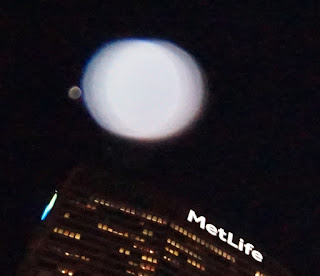
See my posts labeled "air orb too large to be dust" for 86 similar photos, including some showing orbs larger than 60% of the photo height.
The overall reasons for rejecting the idea that orbs are particles of dust near the camera include the facts that many orbs are too big to be dust (for the reasons discussed in this post), too bright to be dust (as shown in my 500+ posts labeled "bright air orb"), too fast-moving to be dust (as shown in my 500+ posts labeled "speeding air orb"), too colorful to be dust (as shown in my 1500+ posts labeled either "blue air orb," "yellow air orb," "purple air orb," "green air orb," "pink air orb," or "orange air orb"), or too far from the camera to be dust (as shown in my 66 posts labeled "air orb too distant to be dust" which often show orbs partially behind distant obstructions).
Further very strong evidence against the idea that orbs are dust is the fact that when I start getting lots of orbs in my photos, I often pull out a piece of cardboard, and photograph it at arm's length; but not once have any of the resulting photos shown a single orb in front of the piece of cardboard. You can see these photos by looking at my 41 posts labeled "cardboard test."
Further very strong evidence against the idea that orbs are dust is the fact that I very often have seen a very strong "vertical bias" in my orb photos -- a tendency for orbs to appear many times more frequently in the upper part of my photos. See my posts labeled "orb vertical bias" for examples. Such photos are completely inconsistent with the idea that the orbs are being caused by natural particles near the camera, for such particles would appear randomly across the photo area, not many times more often in the upper part of the photo. For example, in this series of photos I found there were about 845 orbs that were not in front of a building at the bottom of the photos, and only about 7 orbs that were in front of that building. This extremely strong "vertical bias" is completely inconsistent with any explanation that the orbs were being caused by natural particles (such as dust) very near the camera.
Further very strong evidence against the idea that orbs are dust is the fact that when you attempt to photograph dust in front of the camera (using artificial techniques such as squeezing a dusty cloth right in front of the camera), such as shown here, the resulting dust orbs are dull, colorless, featureless, small, and with blurry edges. Contrast these with the orbs shown on this site, which are so often colorful, bright, and with sharp edges and face-like details or stripes or outer rings.
The diagram below may help to illustrate how absurd it is to try to explain photos like the one above as photos of dust. The diagram shows one tenth of the area right in front of a point-and-click camera lens with a diameter of about 15 millimeters (15,000 microns). The arrow points to a tiny particle that is the size of the largest dust particles floating about in ordinary indoor air (which are only about 10 microns). The particle is so small you won't be able to see it clearly unless you bring up the image in an editor and zoom in. Could a particle this size cause an orb as big as the one shown above? No, it's many times too small. For me to have got a picture like the one above from a floating dust particle would have required a dust particle of some 1500 microns. Dust particles in ordinary outdoor air are only about 1 micron, and if they are ever bigger than 50 microns visibility is sharply reduced.
Postscript: For a discussion of the type of misleading videos and photos produced by skeptics trying to suggest that orbs are dust (which typically involve raising dust levels much higher than normal), see this post entitled, "When Skeptics Engage in Deceptive Cheating."
An explanation sometimes given for mysterious orbs is that they are particles of dust on a camera lens. A small particle resting on a camera lens will absolutely not produce something that looks like an orb in a photo. You can prove that by doing this experiment:
(1) point your camera at the ceiling, with the lens open;
(2) place a tiny particle like a bread crumb on your lens;
(3) take a photo;
(4) blow the particle off of your camera lens.
You will see that the photo absolutely does not show anything that looks like an orb.
Postscript: The images below show orbs I have photographed with the same strange squiggly pattern (as reported here). The probability of coincidentally getting this much pattern repetition from natural particles is zero.
Below is another example of a recurring orb pattern, as reported here. We see six repetitions of an inverted Y pattern, a degree of repetition that would be impossible if natural particles were being observed.
See here for more than 25 other other examples of recurring patterns in mysterious orbs, with such a huge number of pattern repetitions that there is no chance that natural particles could have produced them.
As you can see in this series of posts, I have photographed more than 700 cases of mysterious orbs with stripes (most of which can seen in this video). Each of these is a case of a clear sharp detail appearing in an orb. No such photos can be explained as out-of-focus dust particles near the camera, for we would see no clear, sharp details in an out-of-focus particle near the camera. It is futile to claim that such striped orbs are "striped dust." My photos of 700 mysterious orbs with stripes were published prior to September 5, 2019. But doing a Google search for the exact phrase "striped dust," I see that no has used that phrase before September 5, 2019 in connection with any claim that dust particles can have stripes.
The overall reasons for rejecting the idea that orbs are particles of dust near the camera include the facts that many orbs are too big to be dust (for the reasons discussed in this post), too bright to be dust (as shown in my 500+ posts labeled "bright air orb"), too fast-moving to be dust (as shown in my 500+ posts labeled "speeding air orb"), too colorful to be dust (as shown in my 1500+ posts labeled either "blue air orb," "yellow air orb," "purple air orb," "green air orb," "pink air orb," or "orange air orb"), or too far from the camera to be dust (as shown in my 66 posts labeled "air orb too distant to be dust" which often show orbs partially behind distant obstructions).
Further very strong evidence against the idea that orbs are dust is the fact that when I start getting lots of orbs in my photos, I often pull out a piece of cardboard, and photograph it at arm's length; but not once have any of the resulting photos shown a single orb in front of the piece of cardboard. You can see these photos by looking at my 41 posts labeled "cardboard test."
Further very strong evidence against the idea that orbs are dust is the fact that I very often have seen a very strong "vertical bias" in my orb photos -- a tendency for orbs to appear many times more frequently in the upper part of my photos. See my posts labeled "orb vertical bias" for examples. Such photos are completely inconsistent with the idea that the orbs are being caused by natural particles near the camera, for such particles would appear randomly across the photo area, not many times more often in the upper part of the photo. For example, in this series of photos I found there were about 845 orbs that were not in front of a building at the bottom of the photos, and only about 7 orbs that were in front of that building. This extremely strong "vertical bias" is completely inconsistent with any explanation that the orbs were being caused by natural particles (such as dust) very near the camera.
Further very strong evidence against the idea that orbs are dust is the fact that when you attempt to photograph dust in front of the camera (using artificial techniques such as squeezing a dusty cloth right in front of the camera), such as shown here, the resulting dust orbs are dull, colorless, featureless, small, and with blurry edges. Contrast these with the orbs shown on this site, which are so often colorful, bright, and with sharp edges and face-like details or stripes or outer rings.
The diagram below may help to illustrate how absurd it is to try to explain photos like the one above as photos of dust. The diagram shows one tenth of the area right in front of a point-and-click camera lens with a diameter of about 15 millimeters (15,000 microns). The arrow points to a tiny particle that is the size of the largest dust particles floating about in ordinary indoor air (which are only about 10 microns). The particle is so small you won't be able to see it clearly unless you bring up the image in an editor and zoom in. Could a particle this size cause an orb as big as the one shown above? No, it's many times too small. For me to have got a picture like the one above from a floating dust particle would have required a dust particle of some 1500 microns. Dust particles in ordinary outdoor air are only about 1 micron, and if they are ever bigger than 50 microns visibility is sharply reduced.
Postscript: For a discussion of the type of misleading videos and photos produced by skeptics trying to suggest that orbs are dust (which typically involve raising dust levels much higher than normal), see this post entitled, "When Skeptics Engage in Deceptive Cheating."
An explanation sometimes given for mysterious orbs is that they are particles of dust on a camera lens. A small particle resting on a camera lens will absolutely not produce something that looks like an orb in a photo. You can prove that by doing this experiment:
(1) point your camera at the ceiling, with the lens open;
(2) place a tiny particle like a bread crumb on your lens;
(3) take a photo;
(4) blow the particle off of your camera lens.
You will see that the photo absolutely does not show anything that looks like an orb.
Postscript: The images below show orbs I have photographed with the same strange squiggly pattern (as reported here). The probability of coincidentally getting this much pattern repetition from natural particles is zero.
See here for more than 25 other other examples of recurring patterns in mysterious orbs, with such a huge number of pattern repetitions that there is no chance that natural particles could have produced them.
As you can see in this series of posts, I have photographed more than 700 cases of mysterious orbs with stripes (most of which can seen in this video). Each of these is a case of a clear sharp detail appearing in an orb. No such photos can be explained as out-of-focus dust particles near the camera, for we would see no clear, sharp details in an out-of-focus particle near the camera. It is futile to claim that such striped orbs are "striped dust." My photos of 700 mysterious orbs with stripes were published prior to September 5, 2019. But doing a Google search for the exact phrase "striped dust," I see that no has used that phrase before September 5, 2019 in connection with any claim that dust particles can have stripes.
Thursday, April 2, 2015
Particle Size Analysis Refutes the "Orbs Are Dust" Theory
Cross-posted from www.futureandcosmos.blogspot.com
Orbs are circular anomalies that have been observed in many flash photos. You can see very many examples of orbs by looking at this list of web sites or this web site. These are often big, bright, colorful orbs that often appear to resemble faces, and many of these orbs appear to be moving very rapidly (as you can see by looking at this poster-type image). But skeptics often claim that orbs are just dust. They advance the theory that when you take a flash photograph of orbs under some ordinary conditions, you are really just photographing tiny specks of dust in front of the camera.
This
theory is wrong, and I can tell you by how much of a factor it is
wrong. The theory is wrong by a factor of 1000 times, and is
therefore as wrong as the claim that you can buy a shiny brand new
car for only 20 dollars. The particles of dust in ordinary air are
about 1000 times too small to produce conspicuous orbs in your
photographs.
To
support this claim, I will present a logarithmic chart of particle
sizes. The chart is very similar to many charts that have already
been published, except for the yellow and green parts. You can find
many similar charts on the Internet by doing a Google image search
for “particle size chart.” One such chart can be found here. My
chart uses the same estimates found in such charts. There is no
real controversy or debate about the particle sizes of the items I have
listed here in blue – the great majority of the “particle size”
charts list the same estimates I have listed here (although some list
“heavy dust” as being no larger than 500 microns).
In
this chart I list in yellow a range of particle sizes that might
produce a conspicuous natural orb in your photograph because of a
camera flash reflecting off of a particle in front of your camera. I
define a “conspicuous” natural orb as one that has a size greater than about 3
percent of the original width of the photo. The word “original”
here is crucial. By original, I mean the photo before any cropping
has been done.
Note
that the maximum size of ordinary atmospheric dust is only about 1 micron. But
what is the minimum particle size that might produce a conspicuous
natural orb in a normal photo, one greater than about 3% of the original photo width ? My experiments tell me that the size
is about 1000 microns, or about a millimeter. By a normal photo I
mean a photo taken with a normal camera setting as you might use to
photograph a person, not some “macro-mode” photo in which the
camera lens is extended way out (as you might use to get a closeup
photo of a tiny object).
Specifically:
- I have done tests pouring cinnamon powder near the camera, which produced no orbs. Cinnamon powder has a particle width of about 70 microns.
- I have done tests photographing while vacuuming, which should have raised dust levels to as high as 100 microns. These tests produced no orbs greater than 2 percent of the original photo width.
- I have done tests photographing steam produced by photographing in a steam-filled bathroom. This should have created particle sizes of about 300 microns. No orbs were observed.
- I have done tests photographing mist sprayed in front of the camera, mist from a plant sprayer. This should have created particle sizes of between 100 and 500 microns. This produced a few very small “orbs” (really just droplets), but none that were “conspicuous” as defined above (none greater than about 3% of the original photo width).
So
based on these tests (which all used flash photos), I can conclude
that when using a normal camera setting (not “closeup
photography” settings), you need a particle size of at least about 1000
microns to get a natural dust or vapor orb that is “conspicuous”
as defined above (having more than about 3% of the original photo width).
There is an entirely separate reason for drawing such a conclusion. Those who maintain that
orbs are produced by dust tell us that dust is being photographed in
a little “orb zone” area more than half an inch in front of the camera lens. Such an area would have a length that could not be smaller than about 30 millimeters. So if a dust
particle were to appear in such an area blocking more than 3% of the
original photo width, how big would it have to be? Apparently about 3 percent or more of
this small area that is no smaller than 30 millimeters long – in other
words, about a millimeter (the same as 1000 microns) or larger. If one assumes an even larger "orb zone" width of greater than 30 millimeters, than an ever larger particle size would be needed to block 3% or more of the photo width.
So
both the results of experiments and camera field considerations lead
us to the conclusion that under normal camera settings (not
close-up photography settings) you need a particle size of at least about
1000 microns for some dust or water particle to produce a conspicuous
orb in a photograph (one that is more than about 3% of the original photo
width). But the particles of dust in ordinary air do not have such a
size. Instead they have a size about 1000 times smaller, a size of
only about one micron or less. This is why when skeptics claim
that photos of prominent orbs taken in ordinary air are showing
particles of dust, they are off by a factor of 1000, and are making a
claim as wrong as the claim that you can buy a shiny new car for $20.
Could
it be that when someone photographs an orb they might be
photographing the “visible heavy dust” listed in my chart? No,
that refers to the kind of dust you get in things like a steel
foundry, a building collapse, or a volcanic eruption – dust so
thick you can see the particles in front of you, and feel the
particles collecting on your skin. Particles larger than about 10
microns can be seen with the eye.
Judging
from this link which gives results from a fancy electronic particle
counter, we should not at all expect particles of more than 10
microns to be floating around in typical air in residences or
offices, and
the particles in such air are mostly less than 1 micron.
But
could it not be that when you are photographing an orb, you are
photographing some relatively large particle of dust raised by some
event that happened a few hours ago? No, it is not possible. This is
because particles of dust larger than 10 microns always settle to the
ground fairly quickly. This is shown by the chart below, derived from a chart at this URL.
| Particle Size (Microns) | Settling Velocity (How Fast the Particle Falls) | Settling Velocity (Meters Per Minute) |
| 0.1 | .0000865 centimeters per second | |
| 1 | .0035 centimeters per second | |
| 10 | .306 centimeters per second | .18 meters per minute |
| 100 | .262 centimeters per second | .157 meters per minute |
As
we see from this chart, it takes only about six minutes for a 100
micron particle to fall a meter (about 3 feet), and dust particles of
1000 microns or larger have about the same settling velocity. While
the dust particles in ordinary air (too small to produce orbs) take
quite a while to settle to the ground, all of the larger dust
particles above 10 microns settle to the ground fairly quickly at a
rate of about a meter per six minutes. That means that unless some
dramatic dust-raising event occurred very close to you within about
10 or 15 minutes of the time you took your photo (such as someone
knocking out a wall, beating a rug with a stick, or toppling a large
book case), there is no significant chance that conspicuous orbs
produced in your photo are caused by dust.
This link has 11 photos of orbs that are more than 10
percent of the original photo width. How large would a dust speck have to be
in order to produce such a large orb? It would have to be about
10,000 microns, larger than the width of a pencil (almost as wide as
a dime). Such dust simply doesn't exist, not even in buildings that
are being demolished. It is generally agreed that the maximum size of
heavy dust is only about 1000 microns.
It
would seem that our skeptical friends who claim that most orbs
are just dust simply have not bothered to do their homework. Judging
from their web sites, they apparently haven't done the experiments
they should have done, and apparently haven't bothered to
thoughtfully research the size of particles. So it's not surprising
they've come up with an answer that is off by a factor of 1000.
If
you go to one of the leading web sites of the “orbs are dust”
skeptics, you will find some revealing text in which the author
pretty much “gives away” that he doesn't seem to think dust in
ordinary air is remotely sufficient for producing orbs. In a page
called “How to Take Great Orb Pictures,” the author makes this
revealing recommendation on how to photograph natural orbs that are
just dust:
The
basic idea is to drop or spray small particles close in front of the
lens of the camera while taking flash pictures of an object beyond.
This should yield orbs. Various solids (like flour, cinnamon, etc)
can produce some pleasing, typical-looking orbs.
Here
the writer revealingly seems to give away that he doesn't actually
believe that ordinary photo conditions are anywhere near sufficient
to produce natural orbs caused by dust. He asks us instead to create
some ridiculously extreme and preposterously unnatural conditions in
hopes that this would produce orbs, conditions that would create
particle sizes 1000 times greater than in ordinary air. (I've tried
the cinnamon test, and it doesn't produce conspicuous orbs.)
Such
a recommendation is, of course, ridiculous. A theory that can only
explain orb photos when people drop or spray particles in front of
the camera is worthless for explaining 99% of all orb photos, which
were not taken under anything like such absurdly extreme conditions.
The
bottom line here: the orbs in the great majority of the better orb
photos on the Internet are not photos of dust, because they were
almost all taken in ordinary air, air in which the average dust
particles are 1000 times too small to produce conspicuous dust orbs.
Tuesday, March 24, 2015
Yet Another Experiment Debunking the "Orbs Are Just Dust" Idea
Photo date: March 20, 2015. Photographer: Mark Mahin.
The site www.youtube.com has some videos attempting to debunk orbs. One incredibly silly video features a skeptic pouring huge amounts of dust directly in front of the camera, with the suggestion that this technique can be used to show that orbs are just dust. The approach suggested is, of course, utterly ridiculous. The people who photograph orbs and post them to the Internet as unexplained mysteries are photographing orbs in ordinary air, and are not at all photographing orbs in any condition bearing the least resemblance to a condition in which dust is poured in front of the camera. One cannot explain a phenomenon by using testing conditions totally different from the conditions under which the phenomenon was observed.
A somewhat less ridiculous video shows an experiment in which someone crinkles a wad of dry toilet paper in front of a camera. This method is also objectionable, because virtually never does any one photograph orbs under such a condition, with little specks of dust falling directly in front of the camera. But I decided to give this test a try, just to see whether anything would show up bearing significant resemblance to the orbs that I have produced in my photographs. No such thing happened.
I took 82 flash photos while crinkling some dry toilet paper in front of a dark background, as shown below (the little white specks at the top are falling pieces of dust).
The test does produce a few dust orbs, but none of the 82 photos showed any type of orb that an intelligent person would ever post to the Internet as an example of a possibly paranormal orb or an unexplained mystery. The only orbs that were produced were small, dull, and colorless. All were pale-looking looking little things without any brightness, and without any color other than white or gray. None had interesting outer rings, and none appeared to have faces. None of these dust orbs was any larger than about 5 percent of the photo height. These dust orbs typically had blurred edges quite different from the sharp outer edges shown in very many orb photos on this site. There was no sign of any motion other than the ordinary motion of a falling particle.
A typical example is shown below (and most of the photos showed nothing):
This experiment shows that even when one is causing dust to fall directly in front of the camera lens, this still does not produce orbs anything like the dramatic orbs shown on this site, which are so often bright or large or colorful or having outer rings or facial characteristics or seeming to move in inexplicable ways.
See this post, this post, and this post for similar tests with similar results. The "orb zone theory" is one that does not stand up to scrutiny, and is also an idea that is incompatible with a little thing called the law of gravity. The law of gravity tells us that dust very rapidly settles to the ground, the same thing that one actually observes when one raises dust and uses an electronic dust detector to measure how quickly dust settles. The idea that ordinary air is filled with particles of dust sufficient to create dramatic photo anomalies is a fantasy. Typical, ordinary air at camera level has very little dust, and that invisible dust is not sufficient to show up in flash photos, partially because dust is not a very reflective material.
The site www.youtube.com has some videos attempting to debunk orbs. One incredibly silly video features a skeptic pouring huge amounts of dust directly in front of the camera, with the suggestion that this technique can be used to show that orbs are just dust. The approach suggested is, of course, utterly ridiculous. The people who photograph orbs and post them to the Internet as unexplained mysteries are photographing orbs in ordinary air, and are not at all photographing orbs in any condition bearing the least resemblance to a condition in which dust is poured in front of the camera. One cannot explain a phenomenon by using testing conditions totally different from the conditions under which the phenomenon was observed.
A somewhat less ridiculous video shows an experiment in which someone crinkles a wad of dry toilet paper in front of a camera. This method is also objectionable, because virtually never does any one photograph orbs under such a condition, with little specks of dust falling directly in front of the camera. But I decided to give this test a try, just to see whether anything would show up bearing significant resemblance to the orbs that I have produced in my photographs. No such thing happened.
I took 82 flash photos while crinkling some dry toilet paper in front of a dark background, as shown below (the little white specks at the top are falling pieces of dust).
The test does produce a few dust orbs, but none of the 82 photos showed any type of orb that an intelligent person would ever post to the Internet as an example of a possibly paranormal orb or an unexplained mystery. The only orbs that were produced were small, dull, and colorless. All were pale-looking looking little things without any brightness, and without any color other than white or gray. None had interesting outer rings, and none appeared to have faces. None of these dust orbs was any larger than about 5 percent of the photo height. These dust orbs typically had blurred edges quite different from the sharp outer edges shown in very many orb photos on this site. There was no sign of any motion other than the ordinary motion of a falling particle.
A typical example is shown below (and most of the photos showed nothing):
This experiment shows that even when one is causing dust to fall directly in front of the camera lens, this still does not produce orbs anything like the dramatic orbs shown on this site, which are so often bright or large or colorful or having outer rings or facial characteristics or seeming to move in inexplicable ways.
See this post, this post, and this post for similar tests with similar results. The "orb zone theory" is one that does not stand up to scrutiny, and is also an idea that is incompatible with a little thing called the law of gravity. The law of gravity tells us that dust very rapidly settles to the ground, the same thing that one actually observes when one raises dust and uses an electronic dust detector to measure how quickly dust settles. The idea that ordinary air is filled with particles of dust sufficient to create dramatic photo anomalies is a fantasy. Typical, ordinary air at camera level has very little dust, and that invisible dust is not sufficient to show up in flash photos, partially because dust is not a very reflective material.
Friday, February 6, 2015
Experiments Creating Dust Orbs
When skeptics try to explain away
photographs that show orbs in the air, skeptics give explanations
such as dust, lens flare, and reflection of water vapor. The second
two ideas cannot explain any of the photos of orbs in the air shown
on this site. Lens flare is only produced when you point a camera at
a bright light, and I am careful never to do that (none of the photos
shown on this site were taken facing a bright light). Also, all of
the photos taken on this site were produced in dry air. In fact,
almost all of the photos shown on this site are indoor photos.
But what about the hypothesis of dust –
could that not explain some of the photos of air orbs shown on this
site? To test this idea, I have done some experiments.
The first experiment I did was done a
few months ago, using cocoa powder, an extremely fine powder which
works as a reasonable duplicate of dust. I tried photographing cocoa
powder as I was pouring it into a container. I could see a little cloud of
cocoa dust arising as the cocoa powder was poured; and I could also smell it, meaning that tiny particles of the dust were rising up to my nose.
I examined more than 50 closeup photos
I had taken in this very dusty environment, as visible dust appeared
in the air repeatedly. But the first 50 photos showed not a single
orb. Finally, on something like the 70th photo, I was
finally able to get some cocoa dust orbs showing up in one of my
photos.
But the orbs looked nothing like the
orbs shown on this site. The cocoa dust orbs were small, brown, and
very pale, without any brightness. None of them were more than 5% of
the width or height of the photo, and none of them showed any sign of
motion. Compare that to some of the photos on this site, where some
of the orbs are up to 20% of the photo height, where most of the orbs
are colorful, where a large fraction of the orbs are bright, and
where many of the orbs show signs of rapid motion.
This week I did another experiment
involving household dust. I made a series of photographs while
emptying the dust collection unit of my vacuum cleaner. Emptying the
unit was an extremely messy affair, because there was all kinds of
hair tangled up in the unit. While heavy dust was being raised in the
air as I struggled to get out all the dust from the unit, I took a
series of photos.
It was the same story as with the cocoa
dust. A few orbs showed up in my photos, but they were only small,
dull orbs that showed no sign of motion. None of
these orbs showed any real brightness. A typical example is shown below. You can barely even see them.
None of this should come as any surprise, since we know that dust is a material that reflects little light (and is therefore an extremely poor candidate as an explanation for dramatic orb photos).
The following table summarizes the
differences between the air orbs shown on this site, and the dust
orbs you will get if you raise a lot of dust and take pictures.
| Dust orbs | Air orbs shown on this site | |
| Brightness | Never bright | Often very bright |
| Maximum size | Never more than 5% of photo width or height | As large as 20% of photo width or height |
| Details in orbs | None | Faces, outer ring, bumps, other details |
| Signs of motion | None | Frequent signs of rapid motion (“ghosting effect,” motion blur), including sharp right-angle turns and sharp U-turns |
| Color | Only dull gray or brown | A wide variety of solid colors-- blue, yellow, orange, pink, purple, and green |
| When observed | Only in heavy dust conditions | Almost always photographed in clean, dry air when there is no dust |
It is clear from this summary chart
that one cannot at all explain the air orbs shown on this site by
using dust as an explanation. The “orbs are dust” hypothesis is not
really a serious theory, but just a convenient rhetorical slogan for skeptics, a mere talking point that doesn't fit the facts.
Subscribe to:
Posts (Atom)


